
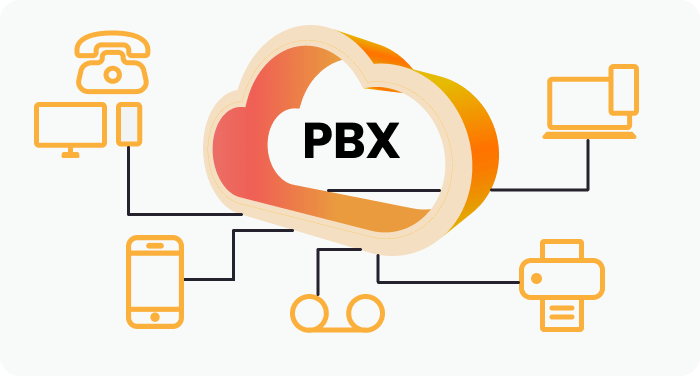
Many companies reach a point where their phone system becomes a bottleneck. As teams expand across regions and service hours extend, on-premise PBX infrastructure starts limiting capacity, routing, and management. An online PBX from DID Global moves call handling into a cloud environment where performance, routing logic, and integrations stay consistent regardless of location.
What an Online PBX Is
An Online PBX is a cloud-hosted communication system that takes over the functions of a hardware PBX.
It is also referred to as a Virtual PBX or a Cloud PBX, since all call processing runs on the provider’s infrastructure rather than on local equipment.
Calls, routing rules, queues, recordings, and user management operate in a centralized platform.
This approach keeps configuration, monitoring, scaling, and maintenance within a single control panel, independent of physical office locations or on-site servers.
Cloud vs On-Premise Systems
The operational differences are straightforward:
On-premise PBX
- depends on hardware capacity
- requires physical updates and local troubleshooting
- scales slowly
- ties teams to office infrastructure
Cloud PBX
- adds users, numbers, and queues on demand
- updates automatically
- supports distributed teams
- centralizes routing and analytics
Companies working across the UK, Netherlands, Cyprus, and distributed support centers typically move to cloud PBX once daily call loads or hybrid work patterns exceed the limits of on-site systems.
Core Features Used in Daily Workflows
Online PBX platforms cover a wide range of tools. The functions that drive operational value include:
- configurable call routing rules
- call queues adjusted by load
- IVR with language or service segmentation
- call recordings linked to user accounts
- monitoring dashboards
- remote agent support from desktop or mobile
- number management for multiple markets
DID Global maintains all routing engines in the cloud, so teams operate under the same logic whether they sit in one office or across several countries.
CRM Integrations That Remove Repetitive Tasks
When Online PBX connects with a CRM system, the information flow becomes continuous.
Companies gain:
- automatic call logging
- caller identification with context from previous interactions
- one-click access to recordings
- synchronized contact and deal data
- performance metrics tied to real activity
Sales and support teams reduce manual updates and eliminate the idle time spent searching for customer history. Integrations with Salesforce, HubSpot, Zoho, Bitrix24, and European CRM systems typically produce the fastest productivity gains.
Productivity Improvements Observed After Adoption
Cloud PBX changes daily operations in measurable ways:
Shorter handling time
Agents receive full context before answering.
Balanced workloads
Supervisors see call distribution by region, time, or team and adjust queues in real time.
Consistent experience for callers
Calls move to available teams automatically when local lines reach capacity.
Hybrid teams notice these effects first. Remote operators work with the same interface and routing structure as office staff, so no separate configuration is required.
Cost Efficiency of Cloud Telephony
Cloud PBX reduces expenses related to:
- hardware maintenance
- PBX expansion hardware
- on-site technician work
- separate systems for different offices
- inefficiencies in outbound routing
Seasonal businesses gain the most cost control, since licenses and call capacity adjust without new contracts or infrastructure changes.
Security Practices for a Cloud PBX Environment
Any cloud telephony deployment must follow strict security controls.
Core protections include:
- TLS/SRTP encryption
- IP whitelisting for SIP access
- multi-factor authentication for administrative accounts
- detailed access logs
- geographic restrictions for call routes
- rate limits to block toll fraud
Misconfigured SIP access is the most common weak point in business telephony. DID Global maintains network-level monitoring and anti-fraud policies to reduce that risk.
Steps for Migrating to an Online PBX
A structured migration minimizes disruptions. Companies typically follow these steps:
- Document existing call flows and peak loads.
- Define required queues, routing rules, and segmentation.
- Port existing numbers or assign new DID numbers.
- Configure CRM and Help Desk integrations.
- Test routing under simulated peak traffic.
- Train operators and supervisors.
- Shift traffic gradually across markets or teams.
Most delays occur when companies skip detailed mapping of existing call flows. Migration speed improves significantly when routing logic is defined before number porting starts.
Recommendations for Smooth Adoption
Teams adapt faster when communication rules and responsibilities are clear. Companies achieve better outcomes when they:
- document how calls should move between teams
- keep IVR structures simple
- review dashboards during the first month to catch anomalies
- delegate basic routing adjustments to supervisors
- ensure remote operators work on stable, secured networks
Consistent communication practices have a stronger impact than the technical setup itself.
Conclusion
Online PBX enables companies to manage voice operations centrally, support distributed teams, and integrate communications with business systems.
DID Global provides the Virtual PBX infrastructure, routing controls, and performance layer required for multi-region operations and scalable communication workloads.
Source: DID Global
