
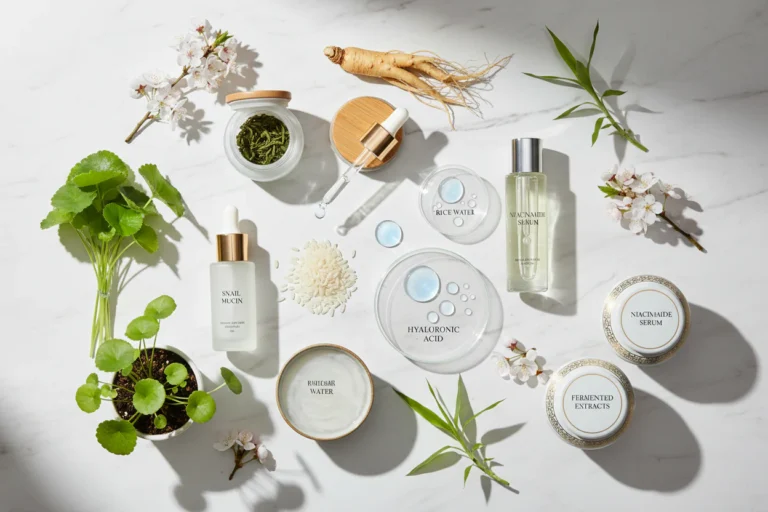
K-beauty’s product volume is its biggest selling point and its biggest problem. Walk into the category cold and you’re looking at thousands of SKUs, overlapping ingredient claims, brand names that are difficult to distinguish from each other, and a language barrier that makes reading the fine print a guessing exercise. Most people resolve this by buying whatever’s trending, which is exactly how they end up with a shelf full of products that don’t address their actual skin concerns.
The smarter entry point is ingredients. K-beauty’s formulation philosophy is ingredient-led — the products that consistently perform over years of real-world use do so because of specific actives and delivery systems, not because of how the marketing is written or how the packaging photographs on a flat lay. Know the ingredients that matter for your skin, and the product selection problem becomes significantly simpler.
Snail Mucin: What It Actually Does and Who It’s For
Snail secretion filtrate — snail mucin — is a K-beauty staple that earns its place through a specific formulation function rather than novelty. It contains a combination of glycoproteins, hyaluronic acid, zinc, and allantoin that collectively support wound healing, hydration, and mild exfoliation at levels gentle enough for daily use on sensitive and reactive skin.
COSRX’s Advanced Snail 96 Mucin Power Essence became a reference product in this category because the 96% concentration delivers the hydration and skin-repair benefits the ingredient is associated with without unnecessary filler ingredients that dilute or destabilise it. The texture is slightly tacky on application and absorbs within thirty to sixty seconds — a consistent indicator of the glycoprotein content doing its work.
Who benefits most: post-procedure skin recovering from chemical peels or laser treatments, barrier-compromised skin struggling with redness and sensitivity, and acne-prone skin dealing with post-inflammatory marks. Who gets less from it: skin without significant barrier concerns that’s looking for targeted brightening or anti-aging — snail mucin supports those functions but isn’t the most efficient route to them.
Centella Asiatica: The Inflammation Answer K-Beauty Got Right
Centella asiatica (cica) is a plant extract with a documented anti-inflammatory and wound-healing mechanism — madecassoside and asiaticoside, two of its active compounds, accelerate collagen synthesis and reduce redness through direct interaction with skin’s inflammatory response pathway. A 2019 review in the Annals of Dermatology confirmed its efficacy for atopic dermatitis and acne-related inflammation at concentrations used in topical formulations.
The K-beauty market built an entire product subcategory around cica because it addresses the two skin concerns most common to Korean climate conditions — seasonal sensitivity from cold, dry winters and oiliness from humid summers. Dr. Jart’s Cicapair range and IUNIK’s Centella Calming Serum sit at opposite price points but both deliver the anti-redness and calming functions the ingredient is valued for.
What cica doesn’t do: it doesn’t directly treat acne bacteria (unlike niacinamide or salicylic acid), it doesn’t brighten hyperpigmentation significantly, and it doesn’t function as a meaningful anti-aging active in isolation. It’s a specialist ingredient for inflammation and barrier recovery, which means it belongs in a routine for those specific needs rather than as a universal first step everyone should take.
Niacinamide and the K-Beauty Brightening Stack
Niacinamide at concentrations between 5% and 10% is the most evidence-backed brightening active in K-beauty formulations — it reduces melanin transfer from melanocytes to keratinocytes, which is the direct mechanism behind fading dark spots, post-inflammatory hyperpigmentation, and uneven skin tone. It also reduces sebum production, strengthens the skin barrier, and is compatible with almost every other active ingredient in a routine, which makes it unusually stackable.
K-beauty’s approach to niacinamide differs from Western formulations mainly in how it’s delivered — essences and lightweight serums rather than thick creams, which affects absorption speed and layering compatibility. Some By Mi’s 30 Days Miracle Toner and Numbuzin’s No.3 Serum are both examples of niacinamide-led K-beauty products where the delivery system is as considered as the active percentage.
The brightening stack that consistently produces results in K-beauty routines: niacinamide serum as a daily active, vitamin C in the morning for oxidative protection and additional brightening, and chemical exfoliation two to three times weekly to clear the surface layer that blocks active penetration. That three-component system addresses pigmentation from three different angles simultaneously and is more efficient than any single ingredient working alone.
Rice and Ferment: The K-Beauty Ingredients Western Skincare Underestimates
Rice water and fermented ingredients (fermented rice water, galactomyces ferment filtrate, bifida ferment lysate) appear frequently in K-beauty formulations for a reason that isn’t immediately obvious from an ingredient list: the fermentation process breaks down compounds into smaller molecular sizes that penetrate the skin barrier more efficiently than their unfermented equivalents.
Galactomyces ferment filtrate — the key active in SK-II’s Facial Treatment Essence and the more accessibly priced Some By Mi Galactomyces Pure Vitamin C Glow Serum — is a by-product of sake fermentation that delivers a complex of vitamins, amino acids, and minerals in a form that the skin absorbs without the barrier disruption associated with some synthetic actives. The luminosity it produces is incremental and cumulative rather than immediate, which is exactly why it doesn’t generate the same viral moment as a product with immediate tactile feedback but remains in serious routines long after trend products cycle out.
Beauty of Joseon’s Glow Serum (niacinamide and propolis) and Dynasty Cream (rice and adenosine) both use fermented or traditional ingredient philosophy to address hydration and brightness through mechanisms that sit outside the standard Western active ingredient framework — which makes them particularly useful additions for skin that’s reactive to synthetic actives at higher concentrations.
Shopping K-Beauty Without Overspending
The K-beauty market’s accessibility in the UK has improved considerably since dedicated retailers like Stylevana expanded their international shipping and pricing structures to make imported formulas competitively priced against UK-stocked alternatives. Stylevana carries a broad cross-section of the brands worth knowing — COSRX, Some By Mi, Beauty of Joseon, IUNIK, Numbuzin, Torriden — at prices that reflect the retailer’s direct brand relationships rather than the markup of a smaller import reseller.
A working Stylevana discount code before a K-beauty order moves those prices further still — getting 25% off at Stylevana on a COSRX or Beauty of Joseon haul brings imported K-beauty firmly within the price range of UK drugstore alternatives that can’t match the formulation specificity. Stylevana promo codes and Stylevana voucher codes update regularly enough to be worth checking before any order, particularly on multi-item purchases where a percentage saving compounds across the basket.
A Stylevana K-beauty discount applied to repurchases — which is where the real annual saving accumulates on a consistent routine — is worth building into the purchasing habit the same way a supermarket loyalty card discount is: not dramatic on any single transaction, significant across a year of consistent skincare spending.
Building a K-Beauty Routine by Concern, Not by Step Count
The step-count obsession in K-beauty coverage (ten steps, twelve steps) has produced more overcomplicated, ineffective routines than almost any other skincare misconception. A well-chosen four or five-product K-beauty routine that addresses your actual skin concern through the right ingredients outperforms ten products layered without a targeting logic.
For acne-prone skin: low-pH cleanser, BHA exfoliant (COSRX BHA Blackhead Power Liquid, two to three times weekly), niacinamide serum daily, lightweight gel moisturiser, SPF.
For hyperpigmentation: low-pH cleanser, vitamin C serum morning, niacinamide serum, AHA exfoliant two to three times weekly, occlusive moisturiser, SPF.
For dry and dehydrated skin: low-pH cleanser, snail mucin essence, hyaluronic acid serum, ceramide or barrier-repair moisturiser, SPF.
For sensitive and reactive skin: micellar or balm cleanser, centella-based toner, galactomyces or fermented essence, fragrance-free barrier moisturiser, mineral SPF.
Notice each routine shares a cleanser and SPF as non-negotiables — those don’t change by concern. Everything in the middle is adjustable by what your skin actually needs rather than what a step-count guide says you should layer.
Q&A: K-Beauty Shopping and Ingredients
Is Stylevana a reliable source for authentic K-beauty products?
Yes — Stylevana operates with direct brand partnerships and is one of the more established international K-beauty retailers, with a product authenticity track record that distinguishes it from smaller grey-market resellers.
Does K-beauty work on non-Asian skin tones?
K-beauty formulations address skin concerns (acne, pigmentation, hydration, barrier repair) that are biological rather than ethnicity-specific. Shade-based products (cushion foundations, BB creams) have historically skewed lighter, but the skincare and treatment side of K-beauty works across all skin tones.
Can I use a Stylevana discount code UK on international orders?
Stylevana ships internationally and Stylevana UK discount codes typically apply sitewide regardless of shipping destination — check the specific code terms, as some are region-specific.
How do I know which K-beauty brands are actually formulation-led rather than just trendy?
Longevity in the community is the most reliable signal — COSRX, Some By Mi, Beauty of Joseon, and IUNIK all have multi-year track records of repeat purchases from people tracking their own skin results, which is a harder test than a single viral moment.
K-beauty’s real contribution to global skincare isn’t the step count or the aesthetic — it’s the ingredient-led formulation philosophy that produces skin results through consistent, targeted application of the right actives. The products are the expression of that philosophy, not the point of it.
